Showing posts with label Ford Model T. Show all posts

The First "Station Wagons"

by Nancy DeWitt
© Fountainhead Antique Auto Museum

As U.S. cities became linked by railroads in the early 1900s, trains became the primary conveyance for overland, long-distance transportation. Hotels and resorts that sprung up along the routes to serve rail travelers used horse-drawn wagons to carry customers and their luggage to and from the railroad depots. These were known as hackneys, or depot hacks.


Automobiles soon replaced wagons at the hotels, starting with surrey-type rigs like the Rapid shown above. Later, hotel owners purchased a chassis from a manufacturer such as Buick or Ford, and had a custom hack body made by a coachbuilder.

The term “station wagon” developed after depots started being referred to as railroad stations around 1910. The Ford Model T was perfect for converting into a station wagon (among other things). It was called a hack if the rear seats were forward-facing, and a jitney if the benches faced each other.

The museum's depot hack was built by Dick Figge of Ohio, who took a standard, 1911 Model T chassis and a Model A crankshaft and built a C-cab body from birch and cherry wood. The C-cab term derives from the unique shape of the cab and roof.

While neither the paint color or hack body are original to our car, it is very eye catching. It draws a lot of attention when we take it to parades, shows, and events like the Golden Days kick-off. Willy was once pulled over while driving the depot hack through downtown Fairbanks. Apparently the policeman just wanted to know what Willy was driving, and if he could take his photo with it. We certainly weren't speeding!

The body on our 1917 Ford Model T Snow Flyer is also a hack, this one made from ash. This Sunday, March 8, we will be giving rides in the Snow Flyer to kids starting at 12:30 p.m. Please drop by!

Coming to see the Fountainhead Antique Auto Museum and other area attractions? Support the museum by staying right here at Wedgewood Resort. 

Reference: Evolution of the woodie station wagon at http://www.woodyguy.net/evolution.html


Charles Bunnell's Excellent Adventure

by Nancy DeWitt
© Fountainhead Antique Auto Museum

This photo was taken in Chitina, Alaska, on September 11, 1914. Robert Sheldon is standing on the far right. Next to him is Charles E. Bunnell, who had recently been appointed U.S. District Judge of the 4th Division by President Woodrow Wilson. Bunnell had hired Sheldon to drive him north from Valdez to Fairbanks so he could campaign for Alaska's Territorial delegate seat in Congress.

Photo courtesy of Frances Erickson
Notice that the car 's body has been removed, and that two wooden chairs have taken the place of the regular seat. Sheldon was concerned that they wouldn’t be able to make it to Fairbanks because of deep mud, so to lighten the load he removed the car’s body and seats, and then strapped two barroom chairs to the chassis. 

“I’ve never sat in a barroom chair before,” growled the judge, “but I suppose there’s always a first time.” 


By the time they reached Paxson, Sheldon and Bunnell had endured two days and nights of steady rain. Five inches of snow greeted them in Isabel Pass. In places the mud was so deep that they had to be pulled through by a team of horses. They didn't arrive in Fairbanks until the evening of September 17. Bunnell lost the election to Judge James Wickersham, but later served as the first president of the Alaska Agricultural College and School of Mines (now the University of Alaska). While there he played a pivotal role in bringing Sheldon's homemade runabout to the University's museum.


Imagine riding on a wooden chair in an open car--for seven days in crummy weather! The Fairbanks Daily News-Miner wrote this about Sheldon's and Bunnell's drive:

Big Trail Has No Terrors for The Auto Driver and His Little Ford. It's Stripped for Action.
The weather may storm and threaten, rain and snow, all of which it did this trip. Mud may get axle deep, bridges may break down, creeks may overflow their banks, all of which was true this time. But Sheldon seems to beat the game any way it is played. He dismantled his machine before leaving Chitina, saving several hundred pounds of weight, and all roads have to give way to him.

Replica of Alaska's First Winning Race Car

by Willy Vinton
© Fountainhead Antique Auto Museum

The replica we've been building of Bobby Sheldon's first race car is almost finished, and the crew that has been working on it took it out yesterday for a spin.
Most of the parts that we used to build this replica were ones I gathered from around the state, so all the parts are of Alaska origin. A good portion came from the Nome area. Nome had a Ford dealer in the early days, and had lots of unsold new parts as well as a large assortment of used items. 


Long-time Fairbanks resident George Clayton flew for Wein Airlines, and he would collect and haul all kinds of items back to town from various villages. George always kept a good inventory of what and where the items originated. He would love to talk about them but would never sell any! Prior to his passing, though, he held an auction and a good amount of his Ford parts were sold to Bruce Campbell in Anchorage. Bruce passed all his collection of Model T parts on to me, and this is where most of the pieces came from for this project. We are grateful that George Clayton collected and saved these parts, and also thank Bruce for allowing me to be able to keep them in circulation to help others with their projects. If you need any T parts, let me know.


Photo of Bobby Sheldon before winning the first
automobile race in Fairbanks in 1917.
Photo courtesy of Frances Erickson
We still need a hood from a Model T to complete the replica, so if you have an old “rough” one, please get in touch with me.

Many thanks to the gang of docents that have been involved in the building of the replica from old and sometimes rusty pieces that I hauled in to the museum. Watch for this fun car driving around Wedgewood Resort this summer.


Coming to Fairbanks to see the Fountainhead Antique Auto Museum and other area attractions? Support the museum by staying right here at Wedgewood Resort. All guests receive half-price admission to the museum!


The First Automobiles in Alaska

by Nancy DeWitt
© Fountainhead Antique Auto Museum

I've started to compile a book about Alaska's automobile history, based on research I've done for signs in the museum and for this blog. While digging through my notes recently I started reviewing what I've learned about the first automobiles to arrive in different Alaska communities. Here's a summary:


Skagway - the first automobiles to pass through Skagway--and Alaska--were likely the Leon BollĂ© Voiturette (right) and another car brought north in 1900 by Count Emile Janne de Lamare of Paris. As best I can tell, neither vehicle was driven in Skagway. Instead, they were transported from a ship directly to the train for shipment to Whitehorse, where de Lamare planned to drive them to Dawson City. You can read about his (mis)adventure here.

The first automobile actually driven in Alaska was also the first one built here: Bobby Sheldon's runabout, built in 1905 in Skagway. Thankfully, the car still exists. Sheldon donated it the University of Alaska's museum in 1935 and it is on loan to us from the University of Alaska Museum of the North.


Nome - The next automobile to be driven in Alaska appears to be this Thomas Flyer. It was shipped to Nome in the spring of 1904 by the Alaska Automobile Transportation Company of Olympia, Washington. It was later purchased by A.E. Boyd of the Alaska Telephone and Telegraph Company.


Valdez - There is a bit of debate about the first automobile in Valdez. Pioneer Ken Rudolph wrote in his memoir that James Fish brought the first horseless carriage there "along about 1904." He then goes on to describe what sounds just like Fish's IHC high-wheeled Auto Buggy, which didn't actually arrive in Valdez until June 9, 1912 (IHC introduced their Auto Buggy in late 1906). I believe that the Thomas Flyer driven by the American team in the 1908 around-the-world race was the first automobile seen in Valdez, arriving April 9, 1908 on the steamship Bertha. In driver George Schuster's written account of the trip he quoted Valdez freighter Dan Kennedy as saying, "It's the first automobile I have ever seen."

Unfortunately the Flyer never made it off the wharf. Likely the first automobile to cruise the streets of Valdez was the 1909 White Model M steamer owned by the Valdez-Fairbanks Auto Transfer Company, shown at right. I have no record of when this car arrived in Valdez.


Ketchikan - The photo of the highwheeler at right is labeled "First automobile in Ketchikan, Governor Wildred B. Hoggatt driving, ca. 1908." I have my doubts about the date and "first auto" claim, as the car pictured is a 1911 IHC Auto Buggy. A Ketchikan Daily article dated June 13, 1908, noted: "Well, well, well! With the advent of a yellow-backed two seated touring car, Ketchikan has again cinched her title as the first city in Alaska. The car is speedy one, though run with only one horse power." I only wish I knew what kind of car they were describing. Perhaps a REO?

Fairbanks -  The first automobile in Fairbanks was this Type XV Pope-Toledo that arrived on August 6, 1908, on the sternwheeler Cudahy. It was shipped in for David Laiti, owner of the Fairbanks Flume Hose Factory. Laiti had also ordered a Franklin and White Steamer that would arrive on a later boat. The photo at right of the Pope-Toledo was taken in 1910, after the car had been sold to Dave Courtemanche.


Cordova - The first automobile in Cordova was a White Model M steam car, purchased by Captain Austin Lathrop to ferry passengers between the docks, railroad, and hotels. It arrived on March 21, 1910 and is shown here with a load of school children on Flag Day that year.

Sitka - The May 21, 1910 issue of Automobile Topics magazine reported that an Ahnut "Six" had been ordered by someone in Sitka. I would love to find a record of it arriving there, and to determine if it was the town's first automobile.

Juneau - Reportedly the first automobile seen by the residents of Juneau in their coastal town was the Abbott-Detroit Bull Dog (right), driven by Charles Percival during his cross-continental durability run in 1911. Percival originally planned to offload the Bull Dog in Juneau for a spin around the town while traveling south from Skagway, but the steamship schedule didn't allow time for that. Instead, the townspeople could only admire the boat on its perch on the City of Seattle's forward deck. A few sources state the first automobile to be driven in Juneau was a second-hand Pope-Toledo brought in by William Burridge, a mechanic working at Martin Lynch's Machine Shop. It appears to have arrived in 1911. I would think that automobiles would have arrived in Juneau earlier than that. I need to follow up on reports of some homemade motor cars and a note that a man named Charlie Rudy had the first automobile in the area.

Ruby - The first auto in Ruby was purchased by a group of citizens to carry freight and passengers between the town and mining camps on the winter roads. Newspaper articles I have do not mention the make of the car, but give a colorful description of its first outing on November 16, 1914 with Morton Adams at the wheel. "With seven men in the car she swung around the corner at the N.C. bridge and was off on the government road up the hill. She flew like a duck; she sang like a bird; she stopped like a mother's cradle and ran like a scared wolf." 

Seward - This photo is labeled "April 24, 1915 arrival of the first automobile in Seward." One source says that Robert Ashland's Model T truck was the first auto in Seward (likely the truck in the photo), while another claims the Pete Ogle's black Ford four-door touring car came there first. 


Circle - In the spring of 2015, a Ford Model T (right) owned by John Palm arrived in Circle, I assume by riverboat on the Yukon River. He used it to transport people and freight between Circle and Miller House at mile 114 of what would later be called the Steese Highway. Palm was driving it in August of 1915 "when suddenly, for some unknown reason, it swerved and jumped into the river," nearly killing him. The car apparently suffered little damage.

Nenana - William Coghill brought the first automobile, a Ford truck, to Nenana on the steamer Tanana on October 14, 1916. That following January, Bob Scanlon drove a Bob Sheldon car with skis under the front wheels from Fairbanks to Nenana--the first automobile to make the overland journey.

Anchorage - Joe Spenard is credited with bringing the first automobile to Anchorage in 1916, a REO truck. Spenard also brought in a 1915 Ford Model T (shown at right), which became the city's first taxi.

If you have information about and/or photos of the first automobiles in any Alaska communities, or corrections to the above, please let us know!

Coming to Fairbanks to see the Fountainhead Antique Auto Museum and other area attractions? Support the museum by staying right here at Wedgewood Resort. All guests receive half-price admission to the museum!


Prepping for Summer

by Nancy DeWitt
© Fountainhead Antique Auto Museum

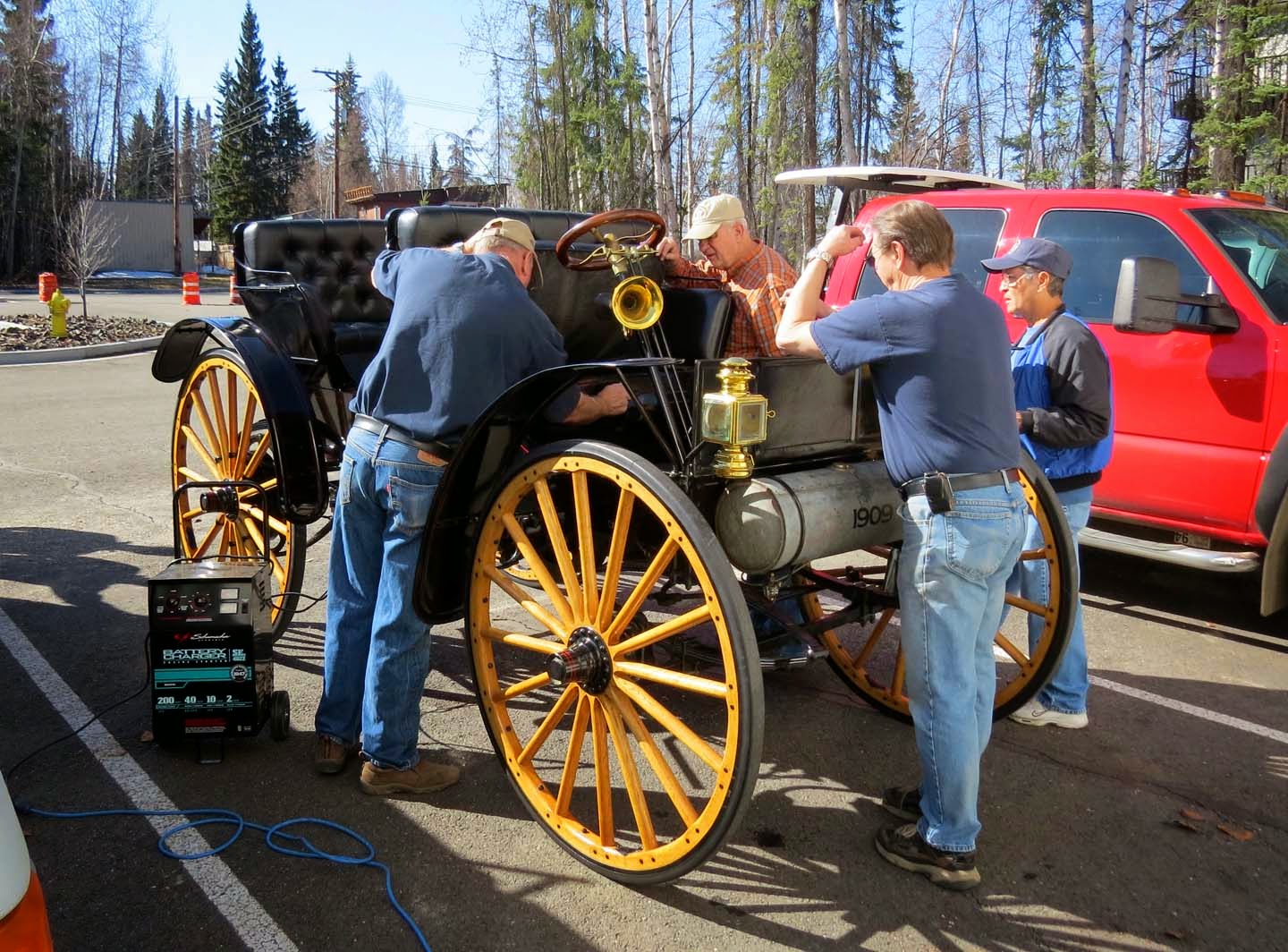
It's been a busy week at the museum. We started moving vehicles into and around the Alaska Gallery to prepare for the opening of our "Extreme Motoring" exhibit. We couldn't find the key for the 1911 Ford Model T depot hack, so it didn't travel far.


Of course, since we had to temporarily move a few vehicles outside while we shuffled cars, it only made sense to fire them up and go for a drive. Willy and the pit crew attracted some curious looks when they drove the IHC auto buggy and Moline-Knight to the Bakery for lunch.


While the guys were playing with cars, Carolyn Mustard continued to install new photographs for the Extreme Motoring exhibit. This has involved shuffling a lot of the existing photographs around the museum--not an easy task.


The pit crew continued to make progress on the Bobby Sheldon replica race car. Looks like the frame is coming along nicely.


Willy got the 1929 Ford Model A coupe moved out of storage and into the garage at the Fountainhead Development corporate office, where it serves as a company car for staff during the summer. He also pulled the 1923 Mercury-bodied Model T speedsteer out of the barn and moved it back over to the museum for the summer.


Finally, the winter covers came off the Duplex truck and Advance steam traction engine outside. We saw our first motor home in the Wedgewood Resort parking, so you know that the summer season is about to hit!


Coming to Fairbanks to see the Fountainhead Antique Auto Museum and other area attractions? Support the museum by staying right here at Wedgewood Resort. All guests receive half-price admission to the museum!


Bakersfield Swap Meet 2014

by Willy Vinton
© Fountainhead Antique Auto Museum


Bakersfield 2014 was hot and dry--almost too hot--but the Alaskans survived it. The first day featured the Horseless Carriage Club of America tour, with a lot of interesting early cars. Of course, a lot of dependable Ford Model Ts were there, but there were some more rare cars like a big Marmon touring, and this great looking Cole V8 coupe. We were offered seats in several cars, but took a rain check as my wife Wilma had to return to the hotel and work (darn computer age). I decided to tour the antique shops around the town, and I managed to buy a hard-to-find item at one: a bottle of old metal jacks (remember the little rubber ball with jacks?). Our wood shop needed these, but that's a story for another time.

The first thing that really grabbed my attention at the swap meet was this rare, 1939 Willys pickup. I believe it may have belonged to Richie Clyne (owner of the Auto Collections at the Imperial Palace) or a friend of his. What a great piece of history it is! The body on it is straight and there is no rust to speak of. I would have liked to bring it home, but have no room at the inn. Sigh.


This model T block is a made-up, open valve built by grinding off all of the enclosure that covered the valve area. The job was very well done, and the price was also very "well done" (it was the same price I paid for a complete engine with transmission a short time ago).

Meet regulars Stan and Terry brought this cute little American Bantam Roadster to the meet to sell. It only took a couple test drives before someone purchased it. And no, Terry didn’t run over Stan, and Stan was not trying to block his passage. It's just that little car = little problems. In this case, the horn wire was shorted out and when you turned the wheel, it would sound the horn.


Now this would make a great tow rig for us! The old twin-six Packard was wearing its original paint, somewhat worse for wear, but a great car with a known history from day one.

As with all the swap meets I travel to, I came home with a few parts. With the cars we have, it's rare to find the things on our wish list, but the hunt is half the fun!


Coming to Fairbanks to see the Fountainhead Antique Auto Museum and other area attractions? Support the museum by staying right here at Wedgewood Resort. All guests receive half-price admission to the museum!


In the Shop: Building a Replica Race Car

Photo courtesy of Frances Erickson

by Willy Vinton
© Fountainhead Antique Auto Museum

Our latest project in the museum shop is to build a replica of the car that Bobby Sheldon drove in the first organized car race in Fairbanks, held on July 5, 1917. The rules required that the cars be stripped down and carry both a driver and mechanic. Sheldon won that race and the $500 prize in a Model T Ford. That was a lot of money at the time--more than the factory price of a new Model T.


Our replica of Sheldon's race car will use parts collected in Alaska from 1916-1925 Model Ts. It will be a nice example of an early race car--and it will run! We've gathered parts from all over for this project, and owe special thanks to Bruce Campbell of Anchorage for helping gather several, including the frame.

The frame we're using is from a 1925 Model T. The major difference between it and the frame from a late-teens model is that it has a wider rear cross member. We aren't going to restore the parts for the replica, but rather, put them into safe operating condition. In fact, they'll probably be in better condition than the parts were in Sheldon's car when he raced!


This project is being performed by our "pit crew" volunteers that come in every Tuesday for a day of fun and work in the museum. I can't say enough great things about these guys. Their enthusiasm and dedication is greatly appreciated.


Here are the front and rear axles we're using for the replica. We'll rebuild them to make them operable and safe for speeds under 50 mph (although we probably won't exceed 20 mph). We haven't decided what wheels to use yet, but will probably go with 30-inch wood.

We are building the engine from several we gathered for usable hard parts. By the time we finish the project the pit crew will have a full understanding of how a Model T operates. Then, we'll move on to a full round of driving lessons so they will all be able to drive a "pedal car" (Model Ts have several pedals to master). When you come to the Midnight Sun Cruise-In in June you should see the Sheldon racer being driven by one of the volunteers and a "mechanic" riding in the passenger seat. If you visit the museum on Sunday, be sure to look through the shop windows to follow our progress.

Coming to Fairbanks to see the Fountainhead Antique Auto Museum and other area attractions? Support the museum by staying right here at Wedgewood Resort. All guests receive half-price admission to the museum!

If you would like to view the first installment of our video series on the build-up, visit our Fountainhead Museum YouTube Channel. 


On the Road: The Henry Ford Museum

by Nancy DeWitt
© Fountainhead Antique Auto Museum

I sit on the board of the National Association of Automobile Museums, and last week I traveled to Dearborn, Michigan for a NAAM strategic planning session. We met in the Benson Ford Research Center, where I was able to spend an extra day researching some of our cars.

The first car built by Henry Ford - 1896 Quadricycle
The Research Center is sandwiched between Greenfield Village and the Henry Ford Museum. The former is the site of the annual Old Car Festival held each September--if you haven't been to that event, you really must go some year. The museum should also be on your bucket list. It's not just about Fords; in fact, it's much, much more than a car museum. You can spend hours looking at impressive displays of airplanes, trains, farming equipment, furniture, machinery, 20th Century technology, and the current traveling exhibit on the movie "Avatar."

Of course, "Driving America" was the star attraction for me. This exhibit showcases the enormous influence the automobile had on American culture. Over 180 cars plus information panels, artifacts, and high-tech touch screen displays cover topics such as road development, marketing, recreation, employment, trucking, auto safety, luxury, and racing. More photos are posted over on our Facebook page.

1920s child's car seat

The first Ford Edsel produced.


Another interesting exhibit is "Presidential Cars." It was very sobering to see the 1961 Lincoln that President John F. Kennedy was riding in when he was assassinated. I was surprised to learn that it had been modified to add more safety features, including an armored steel top and bullet-proof glass, and that Presidents Johnson, Nixon, Ford and Carter used it occasionally.

Of course, the exhibits about the Ford motor car are excellent too. The "exploded" Model T has always been a favorite of mine, but I also enjoyed the Model T assembly exhibit. Here, visitors get to add parts and assemble a Model T each day, which is then disassembled before the next day to start the process all over again.
Yours truly attaching a rear fender

Alas, I didn't have time to take the tour of the Ford Rouge Factory or visit Greenfield Village. Hopefully I will be able to return to the Detroit area again some day.

Bakersfield Swap Meet 2013

 by Willy Vinton
© Fountainhead Antique Auto Museum

I made the annual trek to the Bakersfield Swap Meet a few weeks ago. This year I had the chance to make a day tour with the Bakersfield Horseless Carriage Club  in the company of Greg and Cathy Rising in their 1927 Ford touring car. It was a scenic drive that included a visit to a ranch that raised ostriches. While there, we learned a lot about all the uses of the various ostrich products (feathers, hide, eggs and meat).

On the trip we went over the Tahachapi Pass, which features the Tahachapi Loop, shown at right. This is the only place in the world where a 4,000-foot-long train will pass over itself, gaining 72 feet in elevation along a 2% grade. I had read about the Tahachapi Loop, but this was the first time I had a chance to see it. After a great lunch and tour, we headed back to get ready for the swap meet. The little Ford T ran cool and pulled the hills with ease, without a hint of overheating. Thanks again to the Risings for their hospitality!


This was one of the vendors on the site at Bakerfield Swap Meet. As you can imagine, it takes a lot of time to look through each of the trays, boxes and piles to make sure you don't miss that one treasure you are seeking.

You can also find a few cars for sale at the Bakersfield Swap Meet, like this 1911 Hispano-Suiza "King Alphonso XIII" Double Berline. It's a very unique and unusual-looking beast, to say the least. It looked like someone took a couple of early electric cars and combined them to make a unique form of transportation. It appeared to be a very original car, but since it was not American built, I left it sitting there. Kind of a shame, as we could have hauled lots of gals dressed in their finery around Fairbanks in this one!


Older Post ►
 

Copyright 2011 The Antique Car is proudly powered by blogger.com