by Nancy DeWitt
© Fountainhead Antique Auto Museum
 Last Sunday, we fired up our 1917 Model T Snow Flyer and gave rides around Wedgewood Resort. The Snow Flyer was made from a kit one could buy to covert a Model T into a rig that could travel on snow. A similar kit, pioneered by Virgil White in 1913, was the first time the word "snowmobile" was applied to a tracked snow vehicle. I have yet to document that a Snow Flyer or Snowmobile kit was used in Alaska during the first part of the century, but there were certainly similar kits in use by the mid-20s (Part 2).
Let's first take a look at some earlier creations for motorized snow travel in Alaska. I believe the very first one here was a 2,000-lb steam sled, brought to Valdez by some Connecticut gold seekers in 1898. It consisted of two heavy bobsleds on runners, one fastened behind the other. The front sled carried a 10-hp boiler and an 8-hp reversible engine. The second one carried gearing and a spiked cylinder. The idea was that the spikes would dig into the snow or ice as the sled pulled 15 sledges carrying the miners' freight over glaciers to the Copper River. After being dragged to shore, the boiler was fired up but the sled failed to move and was quickly abandoned on the flats. One historian wrote of the steam sled, "It had the record of being the first automobile in Alaska and was never guilty of exceeding the speed limit."
In 1903, Nome miner James Dawson built an automobile sleigh that he claimed would replace dogs and reindeer. The vehicle featured a crude oil burner and revolving paddles made from the baleen of a bowhead whale. The motor sled at right was invented by W.A. Boice in Nome in 1909. I have yet to find a follow-up story on the sled, which must have caused quite a sensation on the streets of Nome. A similar contraption was described in the Tanana Leader in December of 1909--an autosled made by George Tiffany of Detroit and sent to his son G.H. Tiffany in Tanana. The article said that the 10-hp auto engine failed to develop sufficient power, although the sled did manage to run through the town before breaking down.
Another interesting rig appeared in Alaska in the summer of 1911. The caterpillar motor car consisted of two wooden tracks attached to a 4-cylinder runabout. Each track could be operated separately, and a tracked, "tail-like rudder" in the rear also helped steer the machine. It was built to order for Charles Dankert of Candle, Alaska, by the Emery Machine Company of Seattle. Popular Science magazine claimed it was "probably the first automobile to make an appearance in Alaska," which we know is false. Dankert intended to use it to pull sledges loaded with food and supplies in the Candle Mining District, but I don't know if he succeeded.
In March of 1912, Fred Lewis of Fairbanks built a motor sled consisting of a single front runner, two runners in the rear, a 20-hp engine, and a large, spiked drive-wheel. It was able to reach a speed of 20 mph and successfully covered 20 miles out the Valdez Trail and back on its trial run. After that, I found mention of a number of air-propelled snow vehicles, including one owned by "Reilly" in February of 1918. Apparently it was stuck in Chitina being repaired and reinforced before attempting a run to Fairbanks. The machine at right is Corbett's Air Sled, photographed in Chitina in 1916. I wonder if Reilly built his own air sled, or acquired Corbett's? I have not found documentation that Reilly reached Fairbanks with his.
Probably the most famous air-propelled snow vehicle back then was the aero-sled built in 1916 by well-known musher Scotty Allan of Nome. One newspaper described it as "a combination aeroplane, automobile and the Yukon bobsleigh." It was powered by a 6-hp airplane engine and the propeller "had a tendency to lift the sled when wet snow is encountered." Several newspaper claimed Allan drove his aero-sled from Nome to Valdez and back in 12 days, although I am curious how he was able to obtain fuel along the route for his "gasoline-consuming speedball."
J.H. Miles of Nome also built an air-propelled sled, in 1917. In fact, that were a number of such vehicles built over the next several decades in Alaska, one of which can be seen in a video playing in the museum. These ranged from bobsled-type rigs to ones that resembled airplanes without wings. Here are just two examples:
To see some other air-propelled snow rigs made outside of Alaska, check out this blog.
References:
© Fountainhead Antique Auto Museum
Last Sunday, we fired up our 1917 Model T Snow Flyer and gave rides around Wedgewood Resort. The Snow Flyer was made from a kit one could buy to covert a Model T into a rig that could travel on snow. A similar kit, pioneered by Virgil White in 1913, was the first time the word "snowmobile" was applied to a tracked snow vehicle. I have yet to document that a Snow Flyer or Snowmobile kit was used in Alaska during the first part of the century, but there were certainly similar kits in use by the mid-20s (Part 2).Let's first take a look at some earlier creations for motorized snow travel in Alaska. I believe the very first one here was a 2,000-lb steam sled, brought to Valdez by some Connecticut gold seekers in 1898. It consisted of two heavy bobsleds on runners, one fastened behind the other. The front sled carried a 10-hp boiler and an 8-hp reversible engine. The second one carried gearing and a spiked cylinder. The idea was that the spikes would dig into the snow or ice as the sled pulled 15 sledges carrying the miners' freight over glaciers to the Copper River. After being dragged to shore, the boiler was fired up but the sled failed to move and was quickly abandoned on the flats. One historian wrote of the steam sled, "It had the record of being the first automobile in Alaska and was never guilty of exceeding the speed limit."
 |
| Boice Motor Sled Claus Rodine papers, 1898-1919. ASL-MS-134 |
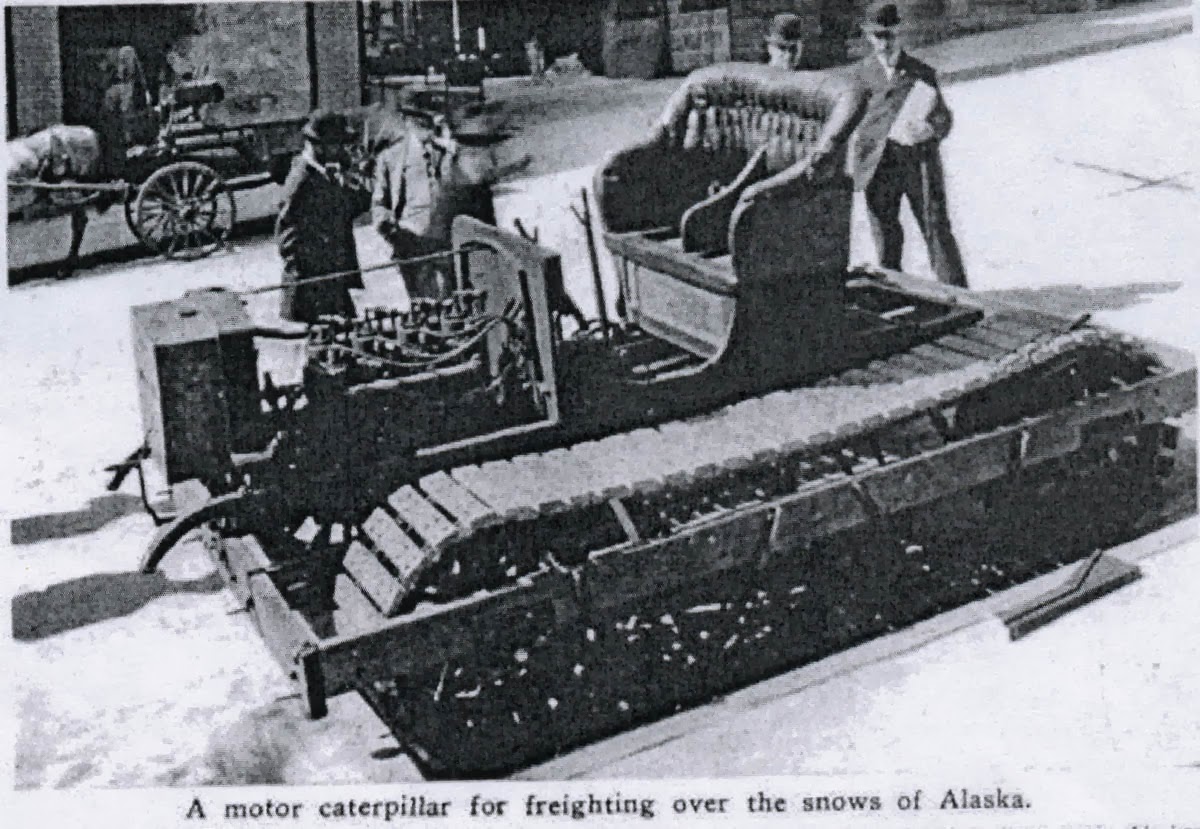 |
| From Motor Age, Vol XX No. 2 |
 |
| Gibson Papers, UAF Archives, 1978-76-23 |
 |
| Photo courtesy of Candy Waugaman |
J.H. Miles of Nome also built an air-propelled sled, in 1917. In fact, that were a number of such vehicles built over the next several decades in Alaska, one of which can be seen in a video playing in the museum. These ranged from bobsled-type rigs to ones that resembled airplanes without wings. Here are just two examples:
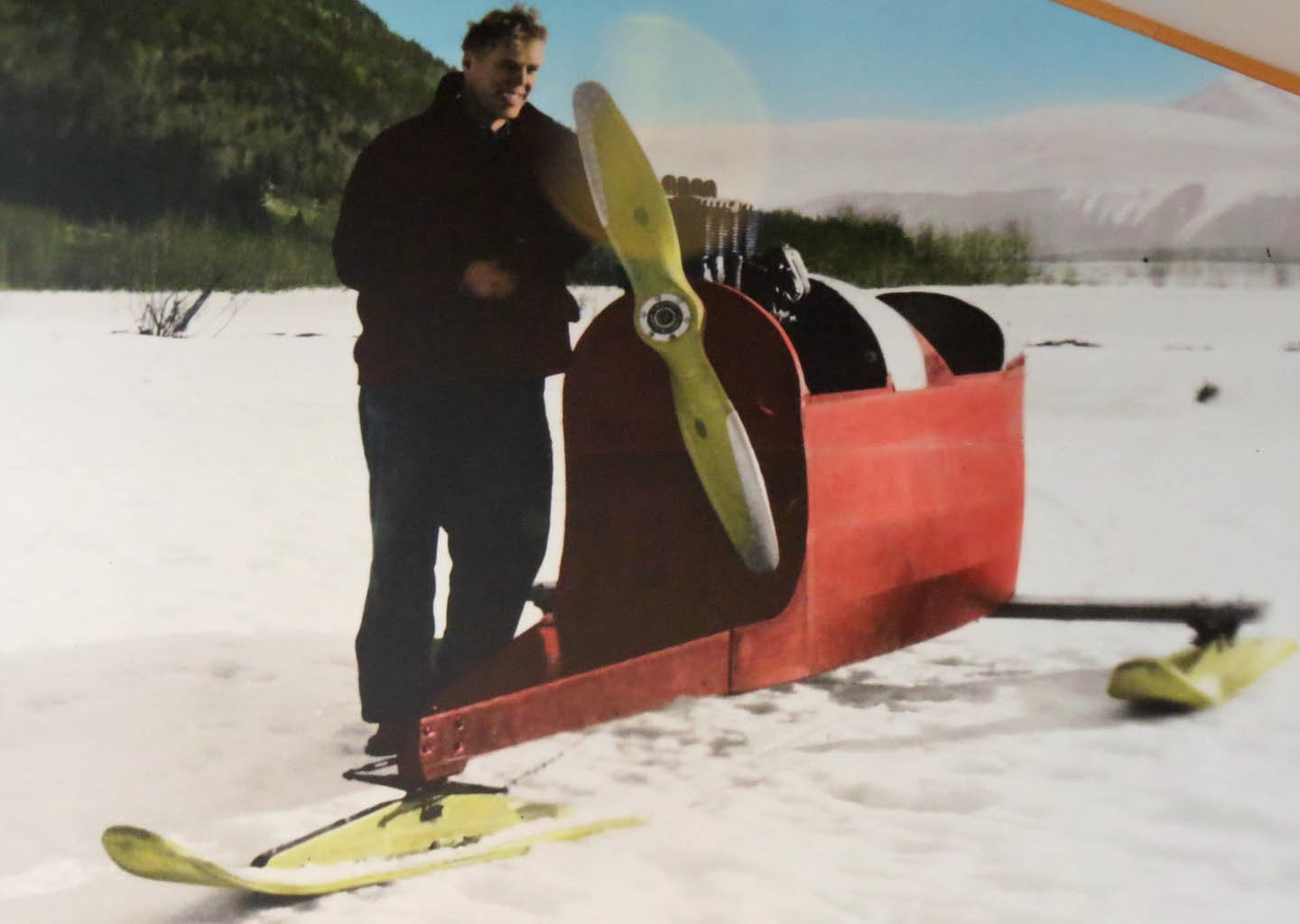 |
| Haines' first snowmobile, the Jitterbug, built by Felix "Whitey" Hakkinen in 1937. The propeller was powered by a 25-hp motorcycle engine converted for aircraft use. During the summer, Hakkinen drove the area's first "airboat" by mounting the Jitterbug's engine and prop on a skiff. This photo and the Jitterbug's propeller and skis are on display at the Sheldon Museum in Haines. |
 |
| One of two snowplanes built by Reverend Augustus "Gus" Martin, shown in Bethel around 1933. Martin built this one in Kwigillingok on the lower Kuskokwin coast, using a Ford Model A engine for power. Martin found his snowplanes to be much faster, less expensive, more protected, and more practical than running a dog team between villages for his missionary work for the Moravian church. |
To see some other air-propelled snow rigs made outside of Alaska, check out this blog.
References:
- "Aero Sled Proves Wonder in Alaska." Dawson Daily News, 12 February 1917.
- "Air-Propelled Auto Coming." Fairbanks Daily News, 27 February 1918.
- Allan, Chris. "Auto Sleighs and Iron Malamutes: The History of Alaska's Earliest Snow-Machines." In Alaska History, Vol. 26, No. 2. Fall 2011.
- "An Auto For Frozen Alaska." Popular Science, 1912.
- "Automobile Arctic Sled." The Yukon Sun, 21 October 1903.
- Colby, Merle. 1939. Alaska: A Guide to Alaska, Last American Frontier. MacMillan, New York.
- Lenz, Mary and James H. Barker. 1985. Bethel: The First 100 Years. A City of Bethel Centennial Project.
- "Makes Trial Run With Motor-Sled." Fairbanks Daily Times, 5 March 1912.
- Margeson, Charles A. 1899. Experiences of Gold Hunters in Alaska. Published by author.
- "Overland Record in Frozen North By Airsled." Moderator Topics, Vol. 37, No. 17. 14 January 1917.
- Powell, Addison M. 1910. Trailing and Camping in Alaska. Wessels & Bissell, New York.
- "The Caterpillar Motor Car." Motor Age, Vol. 20 No. 2. 13 July 1911.
- "Tiffany's AutoSled." Tanana Leader, 23 December 1909.
- "To Copper River for Gold." New York Times, 23 January 1898.
- Vitt, Kurt and Jim Henkelman. 1985. Harmonious to Dwell: The History of the Alaska Moravian Church, 1885-1985. Moravian Seminary & Archives, Bethel, AK.
Coming to Fairbanks to see the Fountainhead Antique Auto Museum and other area attractions? Support the museum by staying right here at Wedgewood Resort. All guests receive half-price admission to the museum!


