by Nancy DeWitt
© Fountainhead Antique Auto Museum
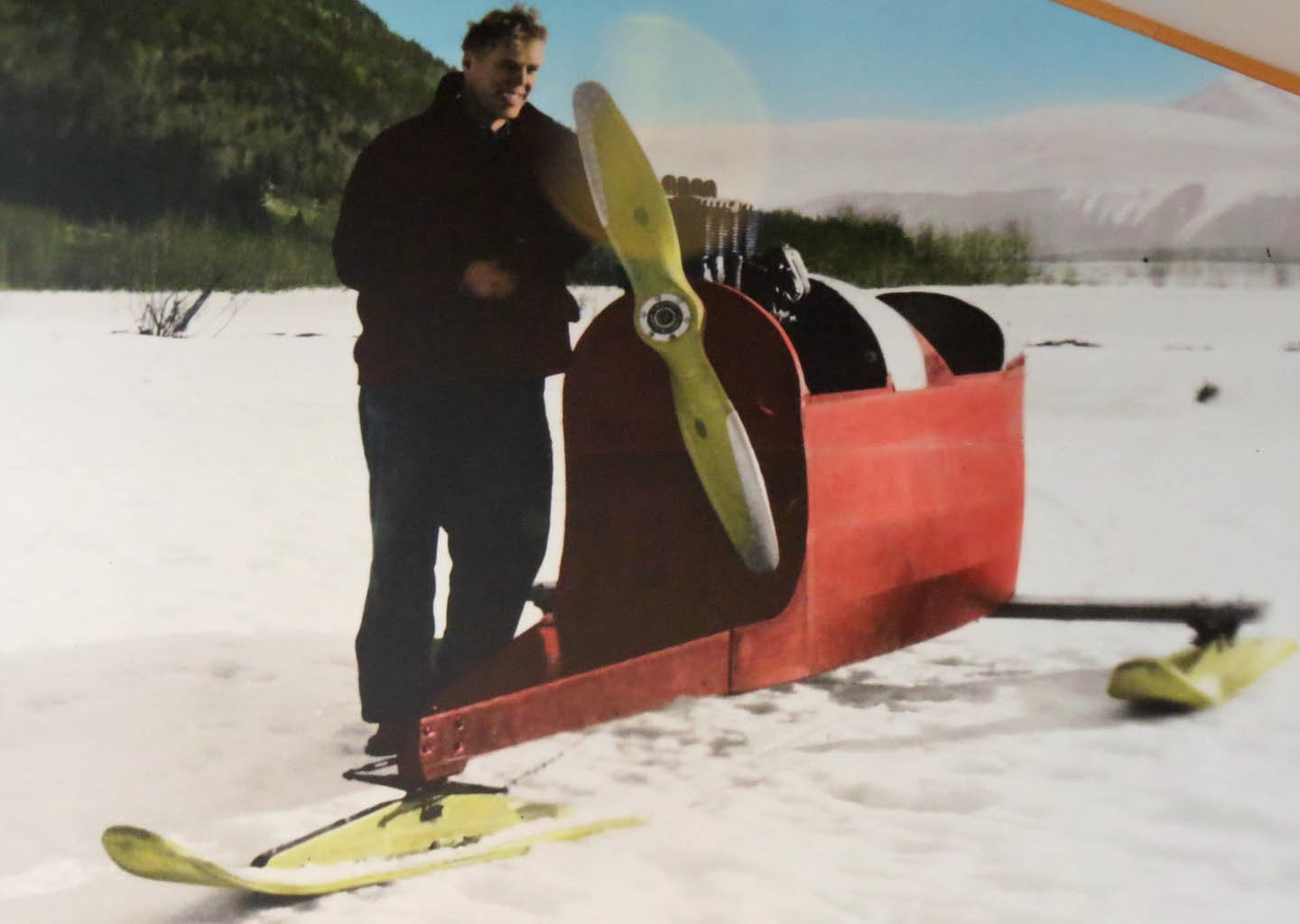
Last week I wrote about several of Alaska's first "snowmobiles," including some air-propelled contraptions (see Part 1). Like a lot of inventions designed to conquer the north's winter terrain, the first two featured here never actually made it to Alaska. The Burch Auto Sleigh at right sat upon skis and two revolving augers, similar to what would be used on the Fordson Snow Motors covered below. Brothers Charles and Frederick Burch made successful runs with it in the Atlin, B.C. district in 1909 and intended to use it to haul passengers between Cordova, Fairbanks and Nome. As far as I know, it never made it across the border.
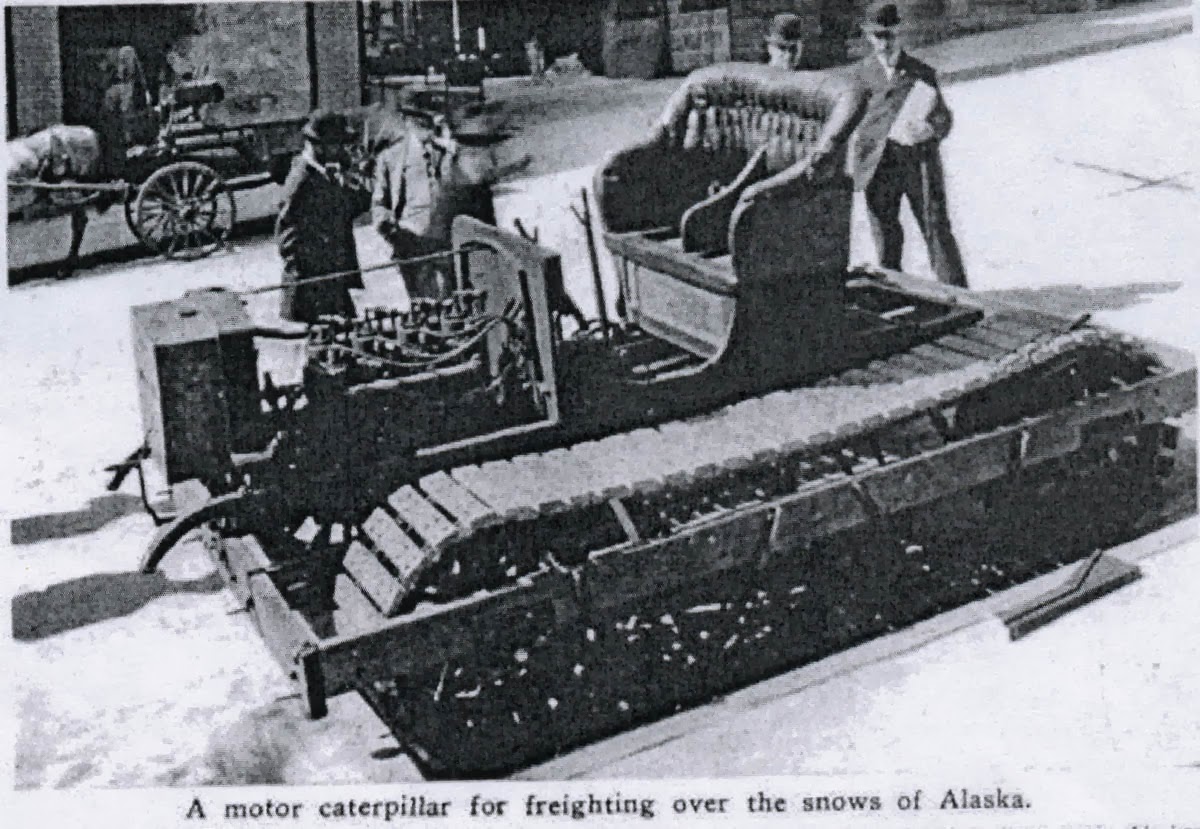
 Frank Horner of Ruby, Alaska (and the namesake for Horner Hot Springs), patented the unusual vehicle above in 1916, which he was sure would replace the dogsled. The Horner Motor-Sled did borrow a few traits from dogsleds. It was long and narrow like a toboggan and had a hickory frame, mounted on runners and reinforced by flexible rawhide. The similarity ended there. Two driving wheels were mounted at the rear and two "idler" wheels near the front, all pneumatics. Two cleated belts connected the font and rear wheels, so it ran somewhat like a caterpillar tractor. The front steering wheel could be raised and lowed depending on the snow's depth and consistency. Horner tested two prototypes of his machine in Ohio, Washington, and Canada, but never brought one to Alaska.
 Meanwhile, Alaska automotive pioneer Robert Sheldon's auto stage business was booming and he began modifying his Model Ts to run on snow. In 1914, he cut down the width of the axles so the wheels would fit in sleigh tracks on the trail to Valdez. He also planned to patent an invention he called the "snowshoe wheel." I don't know if it resembled the snowshoe wheels at right, made by an Idaho inventor in 1912. I have doubts he found much success with his creation, as by 1915 he was simply wrapping chains around his rear tires and strapping skis under the front ones for driving on snow. Still, he was always looking for a better way to get from point A to B. In early 1918 he built a caterpillar tractor automobile that was patented by a Mr. Chambers of Salcha. Nicknamed "Sheldon's Tank," I could find no mention of it after its first few runs.
 Three Fordson Snow Motors were shipped to Alaska in 1926 for the Wilkins transpolar flight attempt. Two were brought in to haul trains of sledges loaded with supplies and fuel from Nenana to Barrow. The first day was a disaster. After sitting through the night at -25 F, both motors were damaged while trying to start them. Once going, they covered less than three miles the first day due to the machines and sleds bogging down in snow drifts, while several members of the crew suffered frostbite. Two days later, after covering only 65 miles and burning through their fuel supply, the Fordsons were declared failures and dog teams were organized to move the supplies north. You can see one of these Snow Motors on display outside our museum.

I found this photo, labeled "Gawne Motor Sled in Nome," on eBay, but know nothing about it. Perhaps one of our readers has some information? It appears to be a Model T mounted on a dogsled-like toboggan, driven by two ridged wheels in the rear and stabilized by side runners.
The vehicle below is equipped with a kit similar to our Snow Flyer, as was the rig I discovered in Valdez several years ago (below right). There were probably a number of these ski-and-track kits sold after the mid-1920s, and I imagine there are more than a few of them slowly deteriorating around Alaska. There was even a Super Snow Bird in Dillingham!


Finally, there was Roaring Boring Alice (a play on Aurora Borealis), a modified Ford Model A that was built by Stanley Morgan of the U.S. Army Signal Corps in Point Barrow in the early 1930s. You can see a video of Alice in our museum. Alice initially carried skis under her front wheels, chains around the rear ones, a second set of skis attached to the rear axle, and a canvas box for a cab. Morgan later replaced the rear assembly with a track from a Ford Snowmobile kit. At one point Morgan became stranded in Alice on an ice floe drifting near Barrow for two months. In 1937, he used Alice to rescue pilot Harold Gillam, who had been forced to land on the tundra during a "Santa Claus" flight to Barrow. I'm told that Alice is still in Barrow. Can anyone out there confirm that?
References:
- "At Army's Most Isolated Outpost in Arctic A Lone Soldier Wins Renown." The Weekly Kansas City Star, 9 October 1935.
- Allan, Chris. "Auto Sleighs and Iron Malamutes: The History of Alaska's Earliest Snow-Machines." In Alaska History, Vol. 26, No. 2. Fall 2011.
- "Auto Sleigh To Make It In 2 Days." Fairbanks Daily News-Miner, 19 May 1909.
- Cole, Terrence M. "Klondike Contraptions: Inventions in Transportation." Northern Review, No. 3/4. Summer/Winter 1989.
- Gaulois, George. "The Motor Sled Versus the Dog Sled." Scientific American, Vol. 124. 29 January, 1921.
- "In 1924, Ford Plus Tracks Plus Snpw Equaled 'Eskimobile.'" Best of Old Cars Weekly
- Prosser, W.T. "New Auto for Snow Travel." Technical World Magazine, Vol. 11, No. 1. March 1909.
- "Tough Going for Snow Motors on Pt. Barrow Trek.: Fairbanks Daily News-Miner, 16 February 1926.
- "Utah Sergeant Goes to Aid of Arctic Pilot." Salt Lake Tribune, 14 December 1937.
- "Wilkins Motor Expedition Stranded First Day Out." Fairbanks Daily News-Miner, 13 February 1926.
Coming to Fairbanks to see the Fountainhead Antique Auto Museum and other area attractions? Support the museum by staying right here at Wedgewood Resort. All guests receive half-price admission to the museum!